
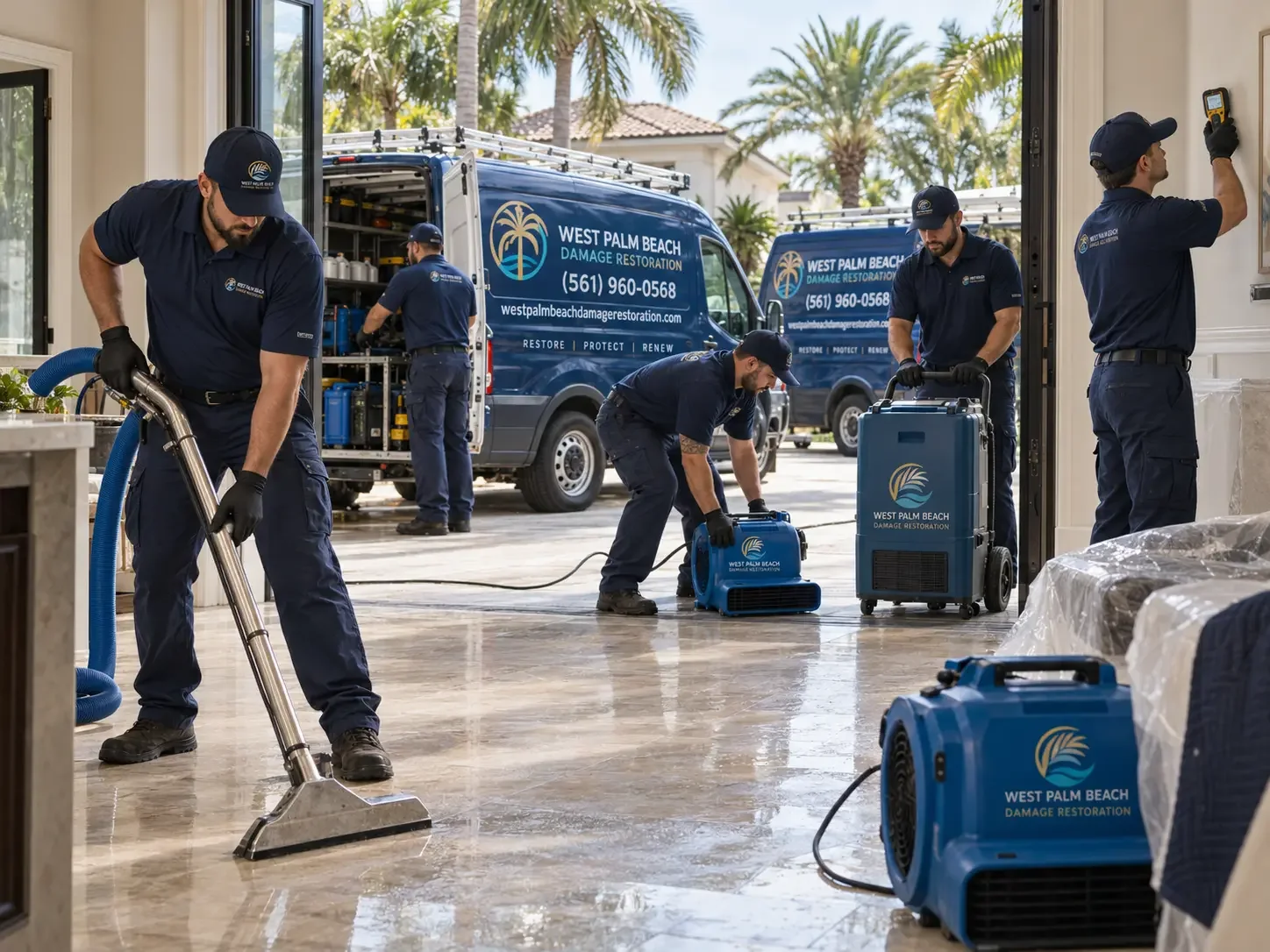
Water damage restoration in Jupiter
Water damage restoration in Jupiter needs a clear account of the source, especially at properties near the Loxahatchee River, Intracoastal or inlet. A waterfront location does not prove that outside flooding caused the loss. A failed supply line, a storm opening and water rising from outside can require different cleanup and coverage discussions.
West Palm Beach Damage Restoration serves Jupiter from West Palm Beach. For a 24/7 emergency inquiry, call (561) 960-0568 with the property address and what you have observed. Report current access conditions and follow local safety instructions before entering a storm-affected building.
Water damage services in Jupiter
Distinguish rising water from rain through an opening
Describe where the water first appeared and whether it entered at floor level, through a roof or window, or from plumbing indoors. If several sources occurred, keep them separate in the timeline. The amount left on the floor does not establish contamination or explain the entire loss.
Outside water can carry residues into the building. Keep people away from affected porous materials until cleanup is assessed. A roof leak may instead require focused ceiling access and a roofing repair, while a supply failure needs plumbing coordination.
Waterfront homes still need a building-specific inspection
A property near the river or inlet may have access and site conditions that matter after a storm, but an individual building’s wet boundary must be measured. Do not rely on a neighborhood label to determine the water category or whether every room is affected.
Inspection should consider floor transitions, wall edges and any level below the apparent source. Tell the team about waterfront-side doors, observed entry points and earlier repairs. Use official property flood information for risk questions; a restoration estimate is not a flood-zone determination.
Ceilings, openings and the repair sequence
Storm-driven rain can affect insulation and finishes above the room before a broad stain develops. If the ceiling sags or changes shape, keep clear rather than puncturing it. Source repair and safe interior access need coordination before the assembly is opened.
Permanent finish repairs should follow the assessment of retained materials. A new roof patch does not dry wet insulation, and a repainted ceiling can hide an unresolved assembly. Ask for the handoff to identify source-trade work, cleanup completion and remaining repair needs.
Plan access after a widespread weather event
Conditions on the route and at the property may change normal scheduling. Tell us if access is blocked, utilities are off or the building has not been cleared for entry. Calling for restoration help does not override an evacuation or re-entry restriction.
For condominiums and managed properties, establish a local contact who can approve access and explain service rules. If the owner is away, arrange authorization and follow-up access in advance. A drying plan needs more than permission to visit once.
A clear path from damage to recovery.
Know what happens next, what the work addresses and what remains to be completed.
- 01First contact
Report the observed entry and access condition
Share the address, first discovery and whether water rose outside, entered from above or came from a pipe. Describe utility and road restrictions before asking the team to schedule an inspection.
A defined starting point - 02Property assessment
Assess contamination and material travel
The wet boundary and affected layers are checked where accessible. The scope should explain the reported source, which materials may be retained and whether concealed edges or rooms below need closer investigation.
An inspection-based scope - 03Restoration work
Remove water while the source is addressed
Extraction and cleanup follow safe entry and source-control planning. A roofer or plumber may be needed separately. Contaminated porous materials should not be treated as a routine clean-water drying job.
Controlled cleanup and treatment - 04Review & handoff
Connect drying evidence to the repair plan
Review readings, removal decisions and any unresolved source issue before rebuilding. Keep the cleanup record, trade repairs and claim documents together so the reason for each stage remains understandable.
A documented next step
Average Water Damage Restoration Cost in Jupiter
Costs depend on the reported water source and the affected materials, not simply on a waterfront address. These base examples use a fixed 200-square-foot area without replacement allowances so you can compare the effect of water category.
| Example scope | Low | Average | High | What drives the price |
|---|---|---|---|---|
| Clean water, 200 sq ft | $1,000 | $1,200 | $1,400 | Extraction and drying allowance; $1,000 minimum applied |
| Gray water, 200 sq ft | $1,000 | $1,350 | $1,700 | Higher cleanup allowance; no replacement add-ons |
| Black / sewage water, 200 sq ft | $1,400 | $2,000 | $2,600 | Contaminated-water allowance; removal and repairs may add cost |
For the entered area, clean-water planning starts at $3.75–$7.00 per square foot. Gray-water planning uses $4.50–$8.50, and black or sewage water uses $7.00–$13.00. The minimum is $1,000; the address does not choose the category.
What changes the estimate?
- The affected square footage and the path into adjoining assemblies.
- The water category and which materials can be retained.
- Drywall, carpet, hardwood, cabinets or ceiling work added to the scope.
- After-hours response, concealed access and mold discovered during inspection.
Coverage depends on the policy and reported cause. Sudden indoor water or fire losses may be covered, while outside flooding raises separate policy questions. Mold may have limits or exclusions. Have the insurer distinguish the sources before relying on reimbursement.
Use the water cleanup calculator to compare source-category scenarios, then confirm the actual cleanup needs through inspection.
Record each source for the coverage review
For a Jupiter claim, an accurate source account is more useful than a broad description such as hurricane damage. Record separate observed entry points, the timeline and safe photos. Ask the insurer which policy responds to each reported cause, especially where outside rising water and rain intrusion both occurred.
A covered sudden water loss remains subject to the policy and deductible. Long-running leakage and flooding can raise different exclusions or coverage requirements. Review the work authorization before proceeding, and keep emergency mitigation separate from the later rebuilding estimate.
Your first-call checklist
- Observed water entry at the floor, roof, window or plumbing.
- Current road, utility and building-entry conditions.
- Waterfront-side finishes and concealed floor edges.
- Owner or condominium-management approval for repeated access.
Keep storm observations separate from assumptions
After a weather event, the temptation is to describe every wet room as one storm loss. A more useful record distinguishes where water was seen entering, which rooms became wet first and which openings or fixtures were affected. That detail helps the cleanup team assess the materials without treating several sources as identical.
Do not assign a precise water depth or start time if no one observed it. State what is known, such as a discovery time or visible mark, and keep uncertain details separate. A factual timeline is more useful to the insurer and source-repair trade than a confident guess.
If access is restricted, document the limitation rather than entering to complete the record. An inspection can describe what was safely observed and what remains unassessed. Photographs from an unsafe roof or flooded electrical area are not necessary to justify a responsible first call.
As restoration progresses, identify overlap between the weather-opening repair and the interior cleanup. A roofer may address entry while extraction handles the floor and drying addresses retained assemblies. Each provider should understand the sequence so new rain does not re-wet materials being restored.
Keep the final scope clear about remaining tasks. Equipment removal may close the drying stage while ceiling repair, contents treatment or an additional source investigation is still pending. That distinction helps you plan occupancy and approvals without equating a quieter room with a completely repaired property.
Water damage questions in Jupiter
Does a waterfront address mean my loss is a flood claim?
No. The actual cause and policy terms matter. A plumbing leak and outside rising water can occur at the same waterfront property. Describe the event and evidence to the insurer; do not label the cause solely from proximity to the river or ocean.
Can you clean up both roof rain entry and floor-level flooding?
We discuss the observed sources and resulting cleanup needs. They may require different material handling and source trades. Tell us if both occurred so the scope and documentation can keep the conditions distinct instead of assuming one uniform water category.
Should I enter to take pictures after a storm?
Follow official re-entry instructions and avoid unsafe structures, wet wiring and blocked access. Photograph only from a safe position. Evidence collection should not take priority over personal safety or create an additional emergency.
Can a ceiling stay wet after the roof is fixed?
Yes. The repair stops entry, while wet insulation or framing may still require assessment and drying. A finish repair should not conceal a questioned assembly. Ask which retained materials were checked before the ceiling is closed.
How do I estimate a multi-room water loss?
Use the approximate affected floor area for planning and describe the room layout separately. The inspection establishes the actual wet footprint. Do not enter the entire house area unless evidence suggests that the whole property is affected.
Do you guarantee immediate arrival in Jupiter after a storm?
Call for current availability and an arrival estimate. Weather, road conditions and safe entry can change the schedule. We take emergency inquiries 24/7 but cannot establish a fixed arrival time before those conditions are checked.