
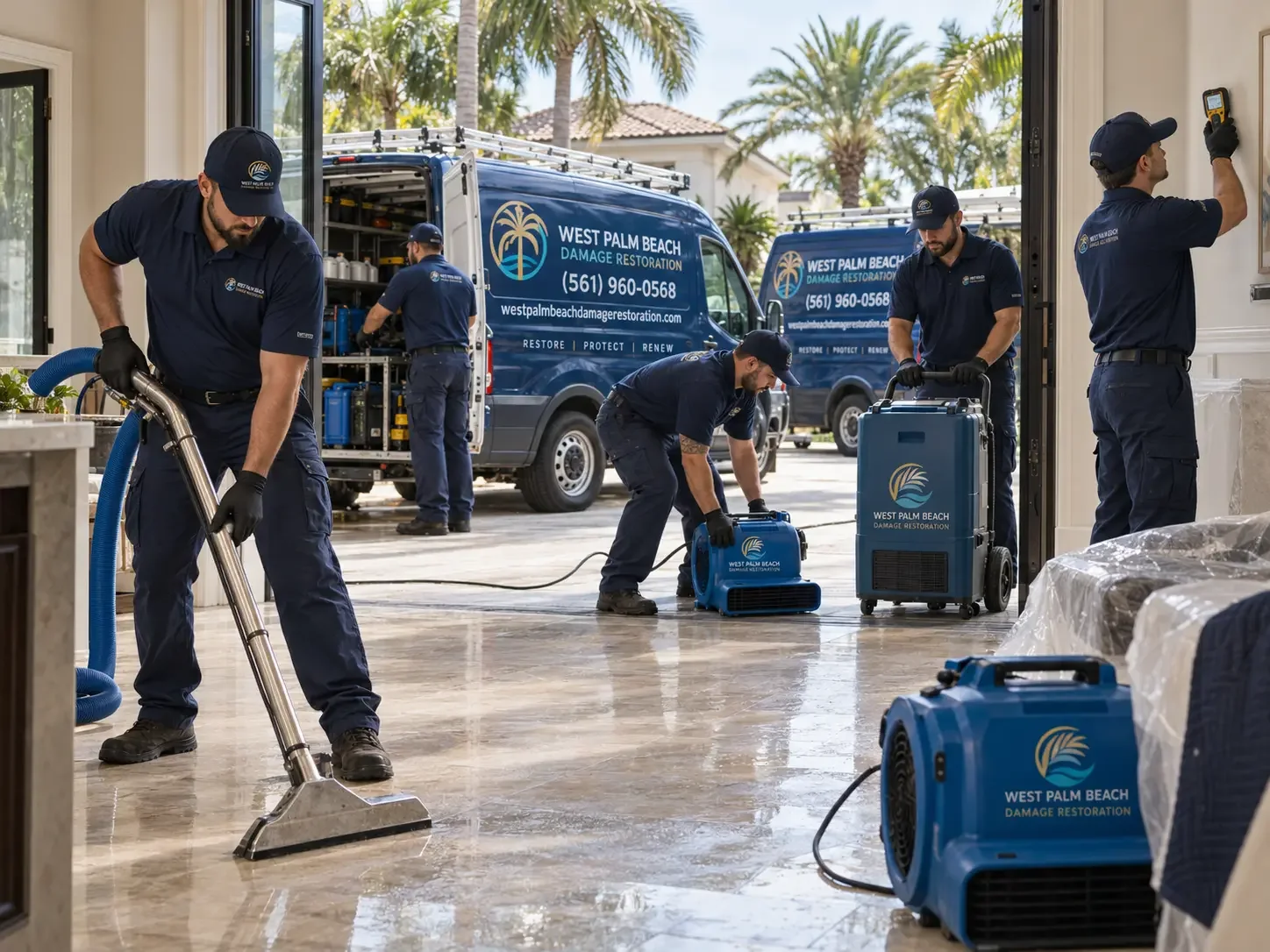
Water damage restoration in Greenacres
Water damage restoration in Greenacres can involve a house, apartment or condominium where the source and affected room belong to different occupants. An upstairs leak may first appear in the ceiling below. Cleanup needs coordinated access and a wet-material assessment, along with a clear decision about who can authorize work.
West Palm Beach Damage Restoration takes Greenacres service inquiries from our West Palm Beach base. Call (561) 960-0568 for emergency help 24/7. Give the building and unit address, affected level, management contact and any source information available.
Water damage services in Greenacres
Shared-building losses need more than one room inspected
Water from an upstairs fixture can enter a lower ceiling, common wall or utility chase. The first visible mark may not identify the origin. Tell the manager about the event and arrange access to the relevant areas before assuming the cleanup is limited to your unit.
The inspection should distinguish the observed wet boundary from ownership and payment questions. Those questions may require the owner, association and insurer, while the restoration assessment establishes the material condition. Opening a shared assembly needs the correct authorization.
Older and altered assemblies can complicate access
Some properties have earlier renovations, repaired wall sections or flooring installed over another layer. Ask what is known about past leaks and tell the team about recent maintenance. A surface that looks newer may conceal an older wet component beneath it.
The decision to open, dry or replace material should explain the condition found. A room’s age alone does not establish that every finish needs replacement. Likewise, a fresh surface does not prove the assembly stayed dry. Keep the assessment tied to evidence.
Appliance and drain incidents in compact spaces
A washing machine, sink or refrigerator leak can affect a small room and adjoining floor edges quickly. Equipment routes may be narrow, and removing wet items can interfere with normal access. Describe the layout so extraction and material handling can be planned.
Wastewater from a backup needs a contamination-specific approach. Do not circulate air from an affected bathroom through occupied rooms with household fans. Keep people out and arrange source repair with the relevant plumbing provider while cleanup needs are assessed.
Coordinate owners, tenants and management
Nominate the contact who approves the work and the person who can provide entry for follow-up checks. The occupant may be the first to discover the damage without having authority to approve demolition. Clarifying the chain of approval prevents confusion once an opening is proposed.
Keep the scope and updates understandable for everyone involved. Note restricted rooms, equipment placement and source-trade appointments. Do not describe a completed extraction visit as a completed repair when flooring, ceiling or cabinet work still remains.
A clear path from damage to recovery.
Know what happens next, what the work addresses and what remains to be completed.
- 01First contact
Collect the unit and authorization details
Provide the full address, affected level and owner or management contact. Describe the first sign and any leak reported by a neighbor. Clarify who can approve inspection and subsequent openings.
A defined starting point - 02Property assessment
Trace the source and wet shared assemblies
Accessible ceilings, walls and floor edges are checked. Further entry may need management coordination. The record should state what was observed and which adjoining areas could not yet be inspected.
An inspection-based scope - 03Restoration work
Clean up with occupant routes in mind
Extraction, contamination handling and drying are planned around safe access. Compact spaces need careful cable and debris routes. Unaffected rooms should not become storage areas for contaminated belongings.
Controlled cleanup and treatment - 04Review & handoff
Provide a staged handoff to the responsible parties
Review drying observations, removed materials and remaining repairs with the authorized contact. Separate the source fix from mitigation and finish work so the owner, occupant and insurer can understand the next step.
A documented next step
Average Water Damage Restoration Cost in Greenacres
A compact unit can have concealed wall or ceiling involvement beyond the apparent puddle. This table compares unselected 200-square-foot calculator scenarios. Shared-building access and actual material decisions require inspection before a firm price is offered.
| Example scope | Low | Average | High | What drives the price |
|---|---|---|---|---|
| Clean water, 200 sq ft | $1,000 | $1,200 | $1,400 | Extraction and drying allowance; $1,000 minimum applied |
| Gray water, 200 sq ft | $1,000 | $1,350 | $1,700 | Higher cleanup allowance; no replacement add-ons |
| Black / sewage water, 200 sq ft | $1,400 | $2,000 | $2,600 | Contaminated-water allowance; removal and repairs may add cost |
In this calculator, the clean-water band is $3.75–$7.00 per square foot, the gray-water band is $4.50–$8.50, and the black or sewage band is $7.00–$13.00. A $1,000 minimum applies to the planned job, not a separate fee per room.
What changes the estimate?
- The affected square footage and the path into adjoining assemblies.
- The water category and which materials can be retained.
- Drywall, carpet, hardwood, cabinets or ceiling work added to the scope.
- After-hours response, concealed access and mold discovered during inspection.
Review sudden water or fire coverage with the relevant insurer, including limits and deductibles. Mold can be excluded or restricted. For a multi-unit loss, clarify which policy addresses each part of the scope instead of assuming one claim covers every party.
See the water damage budget calculator for a scenario range. Arrange unit access and a written assessment for an exact scope.
Clarify policies and parties before billing
A Greenacres multi-unit loss can involve owner, tenant and association responsibilities. Keep the unit address, source report and affected-assembly record explicit. Ask the relevant insurer or manager which policy addresses building finishes, common elements and personal belongings.
A covered sudden incident is still subject to exclusions and deductibles. Drain backup or outside flooding can require separate coverage. Before signing, understand who owes the contractor and what documentation supports each task. The restoration team’s observations do not settle liability between neighbors.
A shared-building inquiry checklist
- Building and unit number, plus the affected level.
- Neighbor or management information about the source.
- Owner authorization for opening or removing materials.
- Narrow access routes and the occupied rooms that need protection.
A clear loss record helps everyone involved
In an apartment or condominium, keep the reported source separate from confirmed inspection findings. A ceiling stain below a neighbor’s bathroom may justify investigation, but it does not by itself prove which fitting failed. Management can coordinate access while the restoration record stays factual.
Ask the owner or authorized manager to review openings and removal before they proceed. Occupants should know which rooms are restricted and how equipment affects daily access. A scope change needs the right approval, particularly when shared walls or finishes belonging to another party are involved.
The equipment and debris plan should account for narrow corridors and common entrances. Wet contents should not be placed in a clean shared area without an agreed handling route. A cleanup inside one unit can affect other occupants if the passageways are not planned.
For tenants, document personal belongings separately from building finishes. Different ownership or policy arrangements may apply, and the restoration team should not decide those responsibilities by assumption. Keep the item inventory and building scope distinct when sending information to the relevant contact.
When the drying stage ends, ask what was checked and which areas remain inaccessible. A limited-access report is better than an unsupported assurance about neighboring units. The final record should identify remaining source work, repairs and any need for further inspection so management can organize the next steps.
Water damage questions in Greenacres
What if the leak came from the unit above?
Notify management and explain which ceiling or wall is affected. Access to the source unit may be needed to establish the cause. The cleanup scope should record inspection limits, while ownership and payment responsibility are reviewed by the appropriate parties.
Can a tenant authorize material removal?
Authorization depends on the property arrangements. Provide the owner or manager contact and clarify approval before openings or disposal. The person reporting damage is not automatically the person empowered to approve a repair contract.
Can a small apartment need substantial drying?
Yes. The visible room size is only one factor; wet layers, ceiling involvement, contamination and access matter. The calculator is a planning tool, not a diagnosis. An inspection establishes the affected materials and whether adjoining spaces are involved.
Should I tell you about previous flooring repairs?
That history is useful. Earlier layers and repaired sections can influence access and concealed moisture. Share known prior losses without guessing about unseen conditions. The assessment should document what is actually found.
Can I use a fan after a drain backup?
Do not use ordinary air movement as a sewage-cleanup plan. Keep the area separate and report the source. Contaminated porous materials may require removal, and surfaces need appropriate cleaning rather than simply being dried.
Who receives the restoration updates?
Agree on an authorized contact before work starts and coordinate with the occupant for access. Where several owners or policies are involved, keep the reports factual and specific to the areas inspected. Ask how changes in scope will be approved.